 Villages Sprinkler Repair
 Irrigation Valve Repair in The Villages
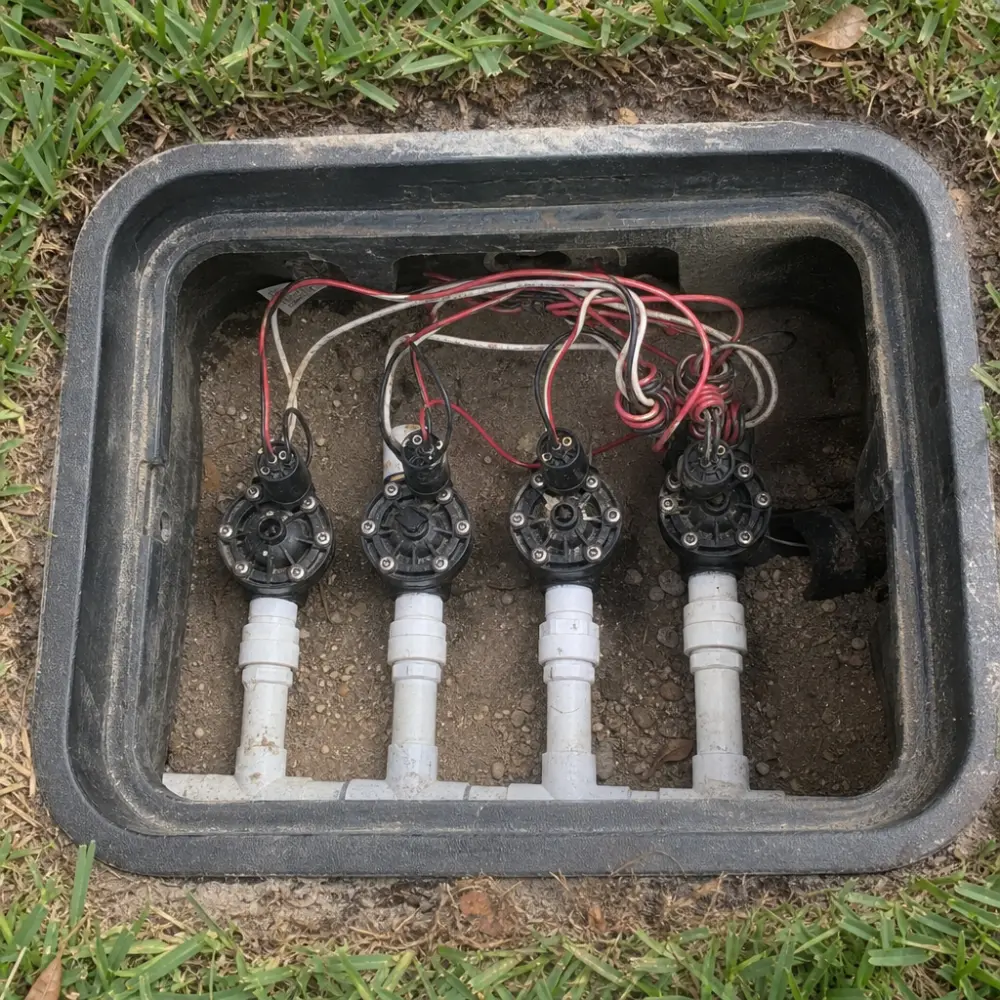
A valve problem shows up two ways: a zone that won’t turn on, or a zone that won’t shut off (including a valve box that stays mysteriously full of water). Repair runs $150 to $350; full replacement, when the valve is too worn or damaged to fix, runs $200 to $450.
What a valve actually does, and how it fails
Each zone has its own electric valve, usually grouped with the others in a valve box or manifold near the water source or property line. The controller sends a low-voltage signal to a solenoid on the valve, which opens a diaphragm and lets water through to that zone’s heads. Two failure modes cover almost every call:
- Won’t open (zone won’t turn on): the solenoid has failed electrically, the wire from the controller has broken or corroded at a connection, or debris is jamming the valve mechanically. The zone stays dry no matter what the controller says.
- Won’t fully close (zone won’t shut off, or the valve box stays full of water): the diaphragm has worn, warped, or has debris caught under it and won’t seat completely. Water keeps weeping through even with the zone technically off, which is what leaves a valve box full of standing water between cycles and can show up as a slow drip or hiss at the lowest head on that zone.
How we diagnose it
A “dead zone” can be the valve, the wiring, or the controller, and they look identical from the surface. The tech traces the circuit: checking the controller’s output to that zone, testing the wire run for a break or short, and opening the valve to inspect the solenoid and diaphragm directly. That’s what tells us whether you need a $150 cleaning and part swap or a $450 full valve replacement, and it’s included in the service call.
What it costs
| Job | Range | Notes |
|---|---|---|
| Valve repair (clean, diaphragm, solenoid) | $150 to $350 | Most common outcome; the valve body itself is sound |
| Valve replacement | $200 to $450 | Body is cracked, stripped, or too degraded to service |
| Wiring repair to a valve (if that’s the actual fault) | Often at the low end of repair pricing | Bundled into the same visit |
If your valves are grouped in a manifold
Many Villages-area properties group several zone valves together in one larger manifold box rather than separate boxes scattered around the yard. That’s convenient for us: multiple valves can often be checked and repaired in a single visit without moving between different parts of the property, which is one reason a system with two or three valve issues at once doesn’t necessarily mean two or three separate service calls.
A valve box full of water is not normal, and it’s not free
It’s tempting to ignore standing water in a valve box, especially if the zone still seems to run fine otherwise. It isn’t harmless: a valve that won’t fully seat is letting treated or non-potable water leak continuously, every hour of every day, not just during your scheduled watering window. On a non-potable system that’s wasted resource; on a potable system it’s wasted water you’re paying for. See our valve box full of water page for the specific signs.
Why this happens more here than average
A lot of Villages-area systems are original to the home, meaning original valves running for a decade or more on the same solenoids and diaphragms, and rubber and plastic components degrade on roughly that timeline regardless of how well the system was built. Debris is the other factor: homes on a non-potable irrigation system (common south of CR 466 and in Districts 5 through 14) draw from stormwater retention and groundwater, which carries more sediment than treated drinking water and is more likely to lodge under a valve diaphragm than in a system on straight municipal supply.
Lightning is a real, if less common, cause too: Florida leads the country in lightning-strike density, and a nearby strike can send a surge through buried wiring that fries a solenoid the same way it can fry a controller.
Getting it fixed
Tell us whether the problem is a zone that won’t run at all, or one that won’t stop, and we’ll get a technician out to trace it. Full pricing for every job is on the pricing page, and the cost calculator will build you a working estimate before anyone arrives.
We serve The Villages, Lady Lake, Wildwood, Leesburg, Fruitland Park, Summerfield, and Oxford at the same published rates.
Frequently Asked Questions
How much does valve repair cost?
$150 to $350 to repair an existing valve (clean debris, replace a diaphragm or solenoid), $200 to $450 if the valve needs full replacement. Both include the diagnosis; a bad valve can look identical to a bad wire or a dead controller output until a tech actually opens the box.
My valve box stays full of water even when nothing is running. Is that normal?
No. A valve box that stays full of water between watering cycles almost always means a valve isn't fully closing, letting water leak past the diaphragm continuously. It wastes water around the clock and is worth fixing rather than living with.
A zone won't turn on at all. Is that the valve or something else?
Could be either: a failed solenoid on the valve, a broken or corroded wire back to the controller, or a bad output on the controller itself. The service call's diagnosis traces the circuit to find which one it actually is before quoting a fix.
Can you find a valve I don't know the location of?
Yes. Most Villages systems group valves in one or two boxes near the water source or property line; if yours isn't obvious, we trace it from the controller wiring rather than digging blind.